The brand is the last decision, not the first
When UAE buyers ask which access control brand to install, they are usually comparing quotations that name different readers. The reader is the most visible part of the system and the least important. What decides whether the system still works in five years is the software platform that manages it, the credential on the cards or phones, how the door hardware is wired to release safely, and who supports it after handover.
This guide covers the brands you are most likely to see on a UAE quotation, where each one fits, and what to ask before you sign. It is vendor-neutral: the right answer depends on the building, not on which brand a supplier happens to stock.
What an access control system is made of
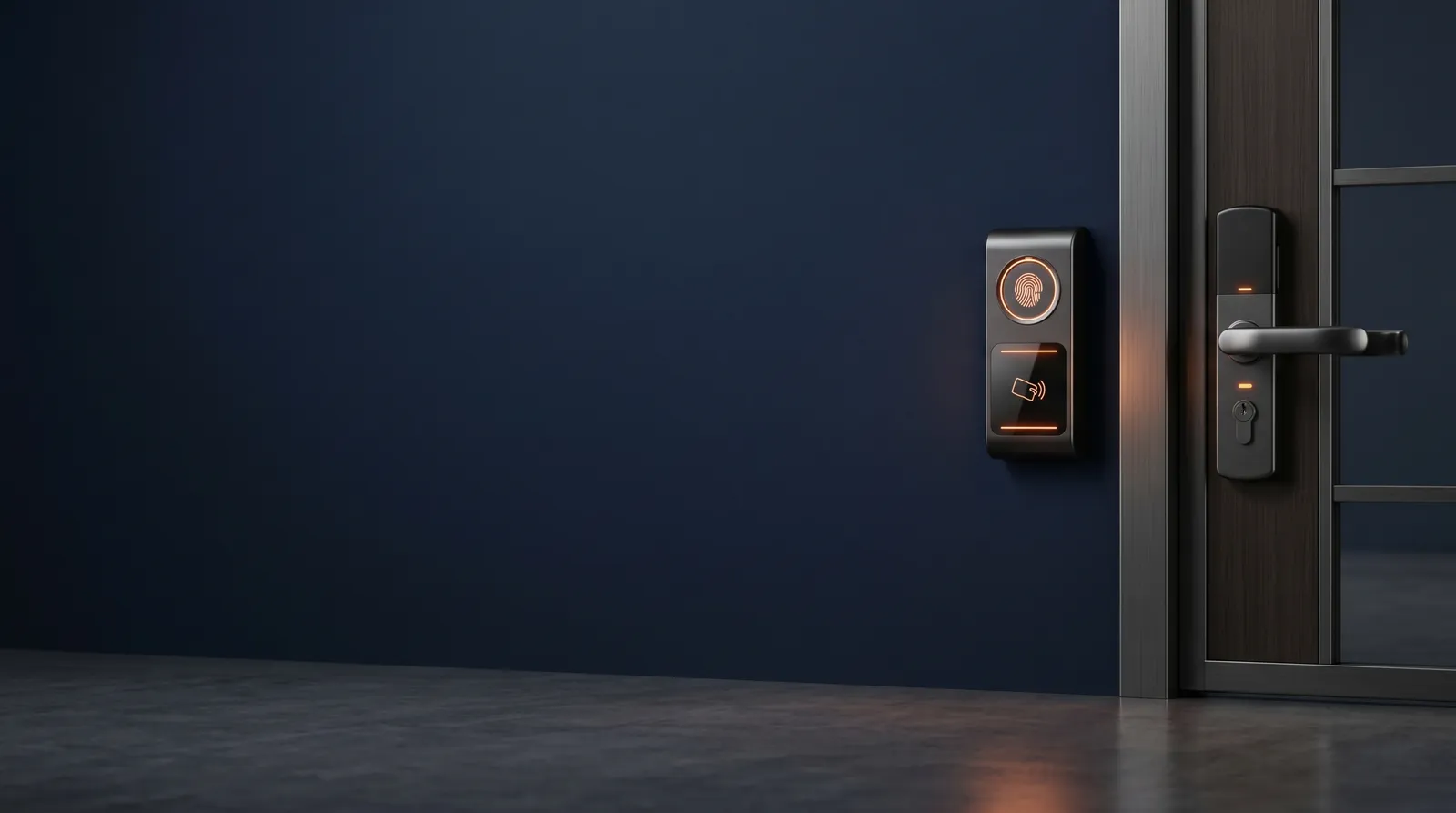
Every system has the same layers. Readers at the door read a card, a phone, a fingerprint or a face. A controller decides whether that credential may pass that door at that time, and drives the lock. The lock holds the door, with an emergency release. Management software holds the users, the schedules and the audit trail. Brands compete at every layer, and several of the names below make only one or two of them.
Suprema
Suprema, from South Korea, is known for biometric readers, fingerprint and face, and for its BioStar 2 management platform, which runs anything from a handful of doors to a multi-building estate. Its RFID readers also read common card formats, so a site can mix biometric doors with card-only doors under one system.
At Yas Driving Academy in Abu Dhabi we installed twelve controlled doors on Suprema XPass dual-frequency readers, rated IP67 for exposed positions, managed under BioStar 2 with capacity to grow to fifty doors.
HID Global
HID is less a complete door system than the credential many other systems read. Its card technologies, proximity, iCLASS and Seos, and its readers sit in front of many different controllers and platforms, and HID Mobile Access puts the credential on a phone. If a building already issues HID cards, keeping that credential and choosing a platform that reads it avoids re-issuing a card to every employee.
ZKTeco
ZKTeco terminals are widely sold across the UAE, particularly standalone fingerprint and face terminals that combine door control with time and attendance. They are a cost-effective choice for small offices, shops and single entrances. Before scaling from one door to fifty, check how the terminals are managed centrally and how the user data they hold is protected.
Hikvision
Hikvision is best known for CCTV, and its access control terminals, face recognition readers in particular, integrate with Hikvision cameras and recorders under its HikCentral software. Where a site is already standardised on Hikvision CCTV, a single view of doors and video is the main attraction. As with any combined camera and door platform, it belongs on a network segmented from the corporate one.
Genetec, LenelS2 and Gallagher: enterprise platforms
At the enterprise end the decision is the platform rather than the reader. Genetec Synergis runs inside Genetec Security Center alongside video. LenelS2 OnGuard is a long-established choice for large corporate and multi-site estates. Gallagher Command Centre is common where security requirements are high, such as government and critical infrastructure.
These platforms support a wide range of readers and integrate with HR systems, visitor management and alarm monitoring. They cost more, and they need an integrator trained and certified on the specific platform, so ask for that certification by name.
What matters more than the brand
Open or closed platform. Ask whether the controllers and software accept readers from other manufacturers, and whether the user database can be exported. A closed system means every future door is quoted by one supplier.
Credential security. Older 125 kHz proximity cards can be copied cheaply. For a new system, specify a secure credential, such as encrypted smart cards, mobile credentials or biometrics, and plan how existing cards will be migrated.
Fail-safe door wiring. Doors on escape routes must release when the fire alarm activates or power is lost. How the locks are wired to the fire alarm and to emergency break-glass units is a life-safety question, not a brand question, and it is where rushed installations most often fall short.
Network and data protection. Controllers and management servers are network devices holding personal data, and in the case of fingerprints and faces, biometric data, which the UAE data protection law treats as sensitive. Put them on a segmented network, keep them patched, restrict and log access to the software, and decide where the records are stored.
Local support. A door that will not open at eight in the morning is an operational emergency. Ask who holds spare readers and controllers in the UAE, what the call-out time is in writing, and whether the engineers who install the system are the ones who maintain it.
Questions to ask an access control supplier in the UAE
Which platform will manage the doors, and can it accept readers from other manufacturers? What credential are you proposing, and how will our existing cards be handled? How are the locks wired to the fire alarm and emergency release? Where are user and biometric records stored, and who can reach them? Who supports the system after handover, and what is the response time in writing? And for security systems in Abu Dhabi, is the installer certified by the Abu Dhabi Monitoring and Control Centre (ADMCC)?
Choosing for your building
For a single office or shop, a standalone terminal from a mainstream brand is usually enough. For a building with a few dozen doors, a networked platform such as Suprema BioStar 2, or a camera-integrated one such as HikCentral, gives central control without enterprise cost. For multi-site estates, regulated sectors and high-security sites, an enterprise platform such as Genetec, LenelS2 or Gallagher earns its price through integration and audit capability.
In every case, settle the credential, the door wiring and the support arrangement first. Then pick the reader.