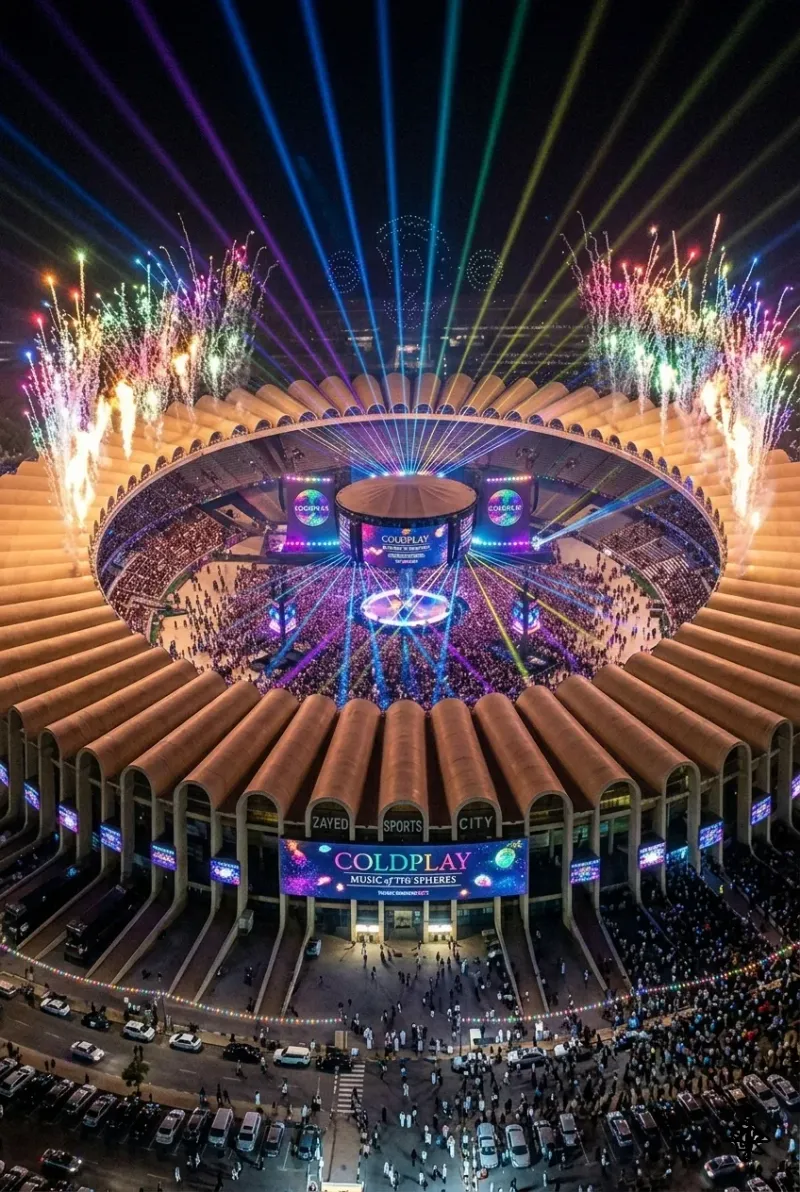
Coldplay Music of the Spheres: Abu Dhabi 2024 Stadium IT Case Study
How IP Care delivered outdoor stadium-scale WiFi, point-to-point microwave backhaul, RFID wristband connectivity and venue CCTV for three nights of Coldplay’s Music of the Spheres tour at Zayed Sports City, 60,000+ concurrent attendees per night, zero show-impacting incidents.
Overview
Stadium concerts at 60,000-attendee scale are a different operational problem than arena events. The crowd is two to four times the size. The venue is open-air, which makes RF behaviour fundamentally different. The show has a fixed run-of-show that does not pause for technical issues. And the modern touring artist increasingly arrives with technical riders that depend on the venue network in ways no concert technology relied on a decade ago.
Coldplay’s Music of the Spheres tour is the most-watched example of that shift. The headline element. The synchronised LED Xyloband wristbands handed out to every attendee, depends on a wireless infrastructure that has to reach every seat in the stadium and synchronise with sub-second precision through the show. That alone moves the IT requirement from "support" to "essential to the show running".
IP Care delivered the IT infrastructure for the three-night Abu Dhabi residency at Zayed Sports City in 2024. This case study walks through what an outdoor stadium concert at this scale actually requires, where it differs from arena or tournament work, and how the build was approached.
The brief
The brief had two halves that pulled in slightly different directions. The first half was the attendee-facing infrastructure: stadium WiFi capable of supporting tens of thousands of concurrent attendees streaming, posting and using cashless payment systems, plus the RFID wristband distribution and synchronisation backhaul, plus event CCTV integrated with venue command and ADMCC.
The second half was the production-side infrastructure: a separate production LAN for the front-of-house mix position, broadcast feed handling for the regional rights holders, secure connectivity for the touring production crew’s laptops and consoles, and the inter-position links between front-of-house, monitor world, lighting control, video control and the spheres-effect control rig at the back of the field.
Both halves had to be live, validated and rehearsed before doors on night one. There is no soft launch for a Coldplay show. The first attendee on the field expects everything to work, and 60,000 attendees follow in the next 90 minutes.
What was different about outdoor stadium scale
Three operational differences from arena work shape the build at this scale.
The first is RF environment. An indoor arena has predictable RF behaviour, known surfaces, known absorption, controlled spectrum. An outdoor stadium has none of that. There is no ceiling to bounce off. There is no shielded perimeter. The neighbouring spectrum environment is uncontrolled and changes through the day as nearby events and weather affect propagation. The WiFi design has to accommodate a fundamentally noisier RF picture, which typically means tighter cell sizes, more directional antenna work, more on-site tuning, and less reliance on automated channel management.
The second is crowd density. A 60,000-attendee outdoor stadium has device density at a level no arena event produces. Peak concurrent device counts cross 75,000 once production crew, security, vendors and back-of-house are factored in. The AP-per-attendee ratio that works in an arena does not scale linearly to a stadium. The geometry, the seating banks, the standing field and the access flows all interact with the wireless coverage plan in ways that require predictive RF modelling and post-deployment tuning that most arena events do not.
The third is weather. Abu Dhabi in concert season is benign relative to many touring stops, but outdoor stadium IT still has to plan for sand, dew on equipment, intermittent humidity surges, and the possibility of an unexpected weather event during the build window. Every piece of outdoor-deployed kit is rated and bracketed for the environment; every cable run that crosses open ground is conduited; every uplink termination has weatherproofing as a requirement, not an option.
The Xyloband infrastructure
Music of the Spheres is built around the Xyloband, an LED wristband distributed to every attendee and synchronised to the show in real time. The wristbands are not Bluetooth devices; they use a dedicated RF protocol on licensed spectrum, driven by transmitters distributed through the venue, controlled by the show’s production rig. The wristband distribution and the show-time synchronisation are the production crew’s responsibility; the venue’s role is to provide the network backhaul that lets the transmitter network reach every seat, the power infrastructure to drive the transmitters, and the spectrum coordination with the national telecom regulator to keep the wristband RF channel clean of interference.
The Xyloband layer is therefore an additional infrastructure overlay on top of the standard stadium WiFi and production networks. It has its own backhaul requirements, its own spectrum coordination, its own dedicated power feeds and its own pre-show validation cycle. The build budget. Both time and kit, for the Xyloband overlay alone is comparable to a mid-sized standalone event.
The kit
Per-night build at Zayed Sports City: approximately 220 HPE Aruba WiFi 6E access points distributed across the bowl, field, concourses, hospitality, back-of-house and front-of-house mix position; a redundant Aruba CX 8325 switching core; an active-passive Palo Alto firewall pair carrying the perimeter; multiple Ubiquiti and Cambium point-to-point microwave links carrying redundant uplinks and reaching the back-of-field production positions where fibre runs were impractical; a temporary production LAN built around Cisco Catalyst 9500 switches for the touring crew’s mix, monitor, lighting, video and spheres-control positions; Xyloband transmitter backhaul on the dedicated RF overlay; an event CCTV layer integrated into venue command and ADMCC retention; and an RFID wristband entry system backhaul for ticketing handoff at gates.
Across the three-night residency, the build was delivered once and operated for the duration, not built and torn down each night. The day-on-day work was validation, tuning and remediation of any minor findings from the previous night.
The numbers
Three consecutive nights. Approximately 60,000 attendees per night, plus production crew, security, vendors and back-of-house. Peak concurrent device count above 75,000 at the busiest point on night one. 220 fan-facing WiFi 6E APs. Six Ubiquiti and Cambium PtP backhaul links across the perimeter. A separate production LAN serving front-of-house, monitor world, lighting control, video control and the spheres-effect control rig. No show-stopping incidents recorded across the three-night run. Two P3 findings. Both fan-WiFi capacity adjustments, caught between nights one and two and remediated for night two.
Operational rhythm
Concert nights run on a fundamentally different cadence than sporting events. A football or basketball game has natural breaks every quarter or half, windows in which a brief technical issue can be observed, diagnosed and potentially intervened on. A concert show has a continuous run-of-show that starts with the artist taking the stage and runs unbroken to the final encore. There are no natural intervention windows. Any issue that emerges during the show has to be observed, diagnosed and remediated transparently to the audience and to the production.
That operational reality shapes the entire pre-show cycle. Doors at 18:00 means an absolute hard deadline of 16:00 for all final validation, with the network operating in steady-state and the operations team in monitoring posture from 16:00 onwards. Any change after 16:00 is by exception only and requires sign-off from the production technical director. The bridge cadence shifts from change-management to monitoring-only.
For three consecutive nights this rhythm runs back-to-back. Day one: build completion, full integration test, dress rehearsal, doors at 18:00, show 20:30 to 23:00. Night-end teardown of non-permanent kit. Day two and day three: validation, tuning, doors, show, post-show. Total time from venue handover to final show wrap: approximately 96 hours including the build-up day. Total time the network is live and being attended: every minute of that 96 hours.
The hardest moments
The hardest single moment was an unexpected spectrum interference event during the night-two soundcheck. A third-party broadcast vehicle parked at the venue perimeter for an unrelated regional event was emitting in a frequency band that bled into one of our PtP backhaul channels at intermittent intervals. We caught it on the spectrum monitor in the NOC, traced the source within 25 minutes through coordination with venue security and the national telecom regulator, and either had the source remediated or shifted our channel allocation before the disruption affected the live show. That kind of cross-venue spectrum interference is the most difficult issue to plan for because it is, by definition, outside the controlled perimeter, and it is the strongest argument for permanent spectrum monitoring at outdoor events.
The second was a sustained capacity finding on the south-end fan WiFi during the closing of night one, when the crowd density in that section was higher than the predictive model had anticipated. The network held but the per-attendee throughput compressed below the design target. We added three additional APs from the contingency pack overnight and the issue did not recur on nights two or three. Predictive RF modelling at this scale is excellent but not perfect; the right answer is to design for the model and stage extra kit for the deviation.
There was no production-LAN incident across the three nights. The Xyloband infrastructure operated within tolerance for every show. The fan WiFi delivered the design throughput everywhere except the south-end finding on night one. The CCTV layer captured everything required and exported cleanly to venue and ADMCC. By the operational measures that matter, the engagement was a quiet residency.
What works
Predictive RF modelling combined with post-deployment tuning. An indoor arena can be designed mostly off the predictive model. An outdoor stadium needs the model plus a live tuning capability that watches the actual RF picture during build and adjusts in real time. The south-end finding on night one was a model-vs-reality deviation; the model said one thing, the reality on the night was slightly different, and the operational discipline closed the gap.
Pre-staged contingency kit. The three additional APs that closed the south-end finding overnight came from the contingency pack on a shelf at the venue. The contingency budget is roughly 15 to 20 percent of the headline kit count on outdoor stadium events, and every event we have run at this scale has drawn on it for at least one finding. It is not an optional line.
Spectrum monitoring as a live capability. The third-party broadcast vehicle interference was caught because there was a spectrum monitor running in the NOC, watched by an engineer on shift. The investment in that capability is small. The downside if it had not been running is large. It is standard practice on every outdoor event we deliver now.
Co-located NOC and production-LAN ops. The fan-WiFi NOC and the production-LAN operations team sat at the same desk inside the same operations room. Issues that touched both networks, which happens, were diagnosed and triaged in a single conversation. The separation of network plant did not mean the separation of operations.
What we would change for a future Coldplay-scale residency
Add a second, fully diverse PtP backhaul path for the production LAN. The current design is well-redundant for fan WiFi and adequate for the production LAN; the upgrade buys margin we have not yet needed but will not regret having.
Move spectrum monitoring from a single-engineer NOC capability to a continuously visualised dashboard view that any engineer on shift can read at a glance. The interference event was caught quickly; the upgrade reduces the dependence on the specific engineer being attentive at the right moment.
Build an outdoor-stadium-specific runbook for nights two and three. The current operating model adapts the arena runbook for the outdoor environment, which works but produces a slightly longer pre-show cycle than necessary. A purpose-built outdoor runbook would shave 30 to 45 minutes off the daily validation window without compromising rigour.
Why this matters for future stadium-scale concerts
The UAE has steadily increased its share of A-list global touring stops. Coldplay 2024 was one of the highest-profile residencies the region has hosted, and the technical envelope of those tours is rising as the artist productions become more sophisticated. Xyloband-style integrated wearable experiences are no longer unusual; they are a baseline expectation for top-tier tours.
For venue operators and event promoters planning to host this category of event, the relevant lessons from the Coldplay engagement are operational rather than architectural. The architecture is well-understood and several credible operators in the region can deliver it. The operating discipline. The predictive-plus-tuning RF model, the contingency kit on shelves, the live spectrum monitoring, the co-located NOC and production-LAN operations, the runbook discipline through the residency nights, is where the gap between a quiet residency and a noisy one actually lives.
Outdoor stadium concerts at 60,000-attendee scale are the operational pinnacle of event IT in the region today. The model that delivered the Coldplay residency is the model that will deliver the next equivalent engagement, with the runbook refinements above. We have brought that model forward into the Saadiyat Nights residency series and other large-scale outdoor concerts that have followed.
Capabilities
What's Included
220+ Outdoor WiFi 6E APs
Bowl, field, concourses, hospitality, back-of-house, front-of-house mix, engineered for 75,000+ concurrent devices on show night.
Redundant PtP Backhaul
Multiple Ubiquiti and Cambium microwave links carrying uplinks and reaching back-of-field production positions where fibre runs were impractical.
Xyloband RF Overlay Backhaul
Network backhaul, power feeds and national spectrum coordination for the wristband transmitter network driving show-time synchronisation.
Production LAN
Cisco Catalyst 9500-class LAN feeding front-of-house mix, monitor world, lighting control, video control and the spheres-effect control rig.
ADMCC-Aligned Event CCTV
Venue and event CCTV integrated with command centre and ADMCC retention standards for the duration of the residency.
Live Spectrum Monitoring
Continuous spectrum visualisation in the NOC, caught and remediated a third-party interference event during the night-two soundcheck.
Why IP Care
What Sets Us Apart
Our Delivery Approach
How We Deliver
A proven, repeatable approach, used on every engagement.
Pre-Show Build (T-4 to T-2 days)
Site survey, AP install, PtP backhaul, production LAN build, Xyloband transmitter overlay backhaul, national spectrum coordination.
Show Day (T-1 to doors)
Full integration test by 14:00, dress rehearsal, soundcheck, hard validation freeze at 16:00, monitoring posture from 16:00 to doors.
Show Operation
Continuous monitoring through run-of-show, co-located NOC and production-LAN ops, no-change exception-only policy after doors.
Between Nights
Non-permanent kit teardown, contingency-pack remediation of any findings, validation and tuning ahead of next night doors.
Post-Residency
Full teardown, asset retrieval, ADMCC CCTV export, post-event report into runbook for future stadium-scale residencies.
Who It's For
Industries We Serve
Certifications & Compliance
Credentials Behind Every Engagement
You May Also Need
Related Services
High-Density Event WiFi
WiFi 6 / 6E / 7 engineered for 1,000+ concurrent users per AP cluster. RF planning, heat-mapping and on-site tuning.
ExploreTemporary Data Centres
Full NOC-grade compute, storage and networking deployed to site in portable racks with redundant power and cooling.
ExploreEvent CCTV & Security
IP CCTV, crowd analytics and ANPR integrated with live monitoring and event command centres.
ExploreQuestions & Answers
Frequently Asked Questions
Ready to Get Started?
Talk to our UAE-based team for a free consultation and a tailored proposal, typically within 48 hours.