Testing Equipment Rental, UAE & Canada
If the cable fails cert, the whole job stops. We keep the Fluke DSX 5000, AFL Noyes M210 OTDR and a fusion splicer ready to ship, so your crew has the right gear on-site, not the closest substitute.
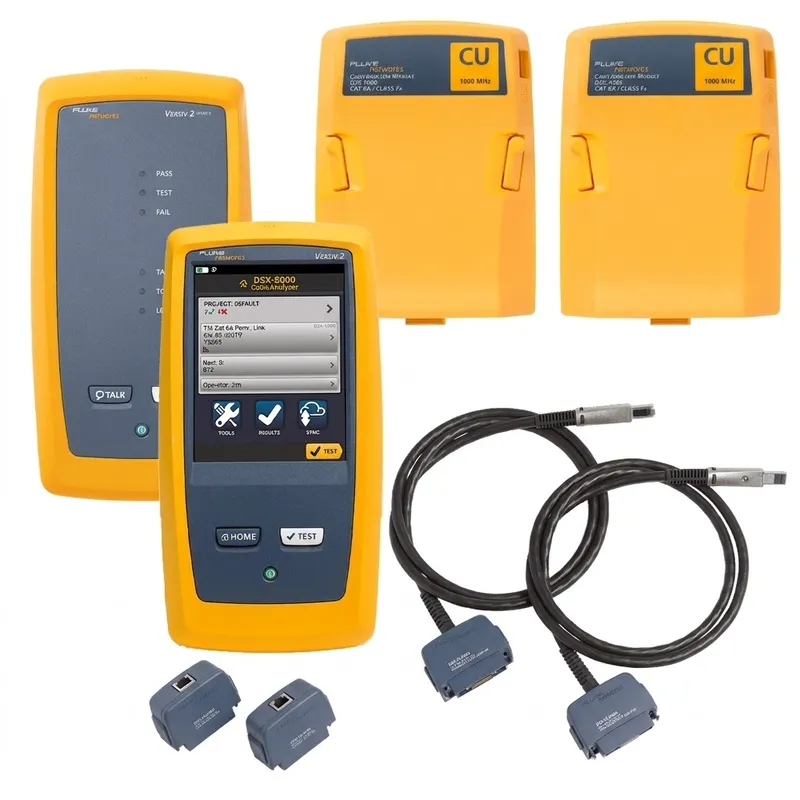
DSX 5000 CableAnalyzer
- Certifies Cat 5e to Cat 6A at 500 MHz, pass/fail in under 10 seconds
- Tests PoE up to 60W so you know the port delivers before the AP goes up
- LinkWare Live: reports sync to the cloud before you've packed the kit
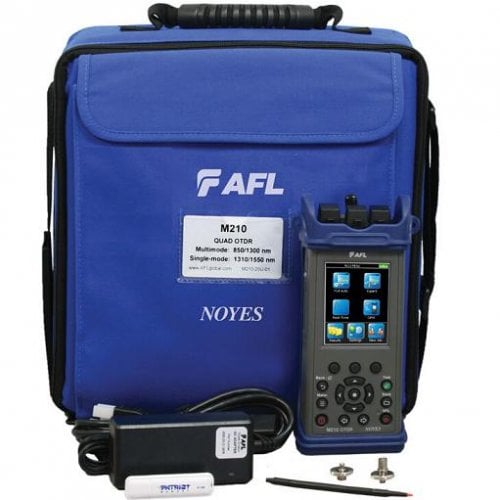
M210 OTDR
- Traces singlemode and multimode fibre, one unit, both jobs
- 1310 / 1550 nm wavelengths catch faults, reflections and losses most gear misses
- Compact and field-rugged, fits in a backpack, no cart required
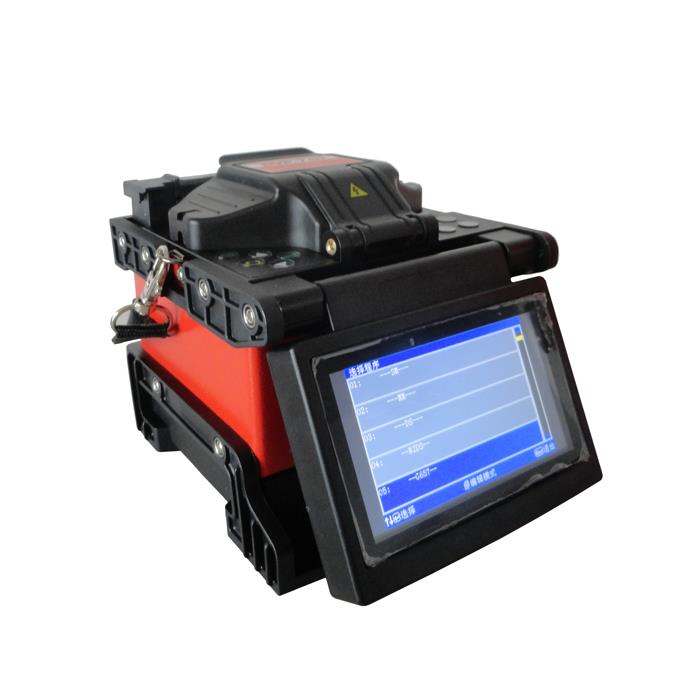
Fusion Splicer Kit
- Arc-fusion splicing with sub-0.02 dB typical splice loss
- Built-in fibre cleaver + heat-shrink oven, everything in one carry case
- Ruggedised case with battery backup rated for full off-grid site days
Certification tools get rented rather than bought because the maths rarely works otherwise. A cable certifier is used hard for the two weeks of a handover and then sits in a cupboard depreciating, needing annual calibration to stay valid. Renting puts a calibrated instrument on site for the window you actually need it, which is usually the difference between a handover that passes and one that gets disputed.
Certification, not verification
These are different things, and consultants reject handovers over the distinction. A verification tester tells you a cable is connected and roughly working. A certifier measures against the TIA or ISO standard — insertion loss, NEXT, return loss, delay skew — and produces a pass or fail traceable to that standard. Only the second is accepted as a handover document.
The Fluke DSX 5000 certifies Cat 5e through Cat 6A to 500 MHz and uploads results to LinkWare Live, so the report is in the cloud before the kit is packed. On a contested handover, that report is the thing that ends the argument.
Copper, fibre, or both
Most infrastructure jobs need more than one instrument. Copper runs need certification. Fibre runs need an OTDR trace to prove loss budget and locate faults by distance. Where fibre has been damaged or needs extending, a fusion splicer makes the join properly rather than leaving a mechanical connector in the path to fail later.
The AFL Noyes M210 handles singlemode and multimode in one unit at 1310/1550 nm, with a 0.8 m event dead zone that resolves faults close to the launch point where cheaper units are blind. The Fujikura fusion splicer holds typical splice loss below 0.02 dB, which keeps a repaired run inside its original loss budget instead of eating headroom the design did not have.
Calibration and what arrives with the kit
Instruments ship with current calibration. This matters more than it sounds: a certification report from an out-of-calibration tester can be rejected outright, which means re-testing the whole installation at your cost. Ask for the calibration status when you book if your consultant requires it on the handover pack.
Adapters and consumables travel with the instrument — permanent link and channel adapters for the DSX, cleaver, electrodes and carry case for the splicer. Delivery, collection and setup are included in the rate. Operator training, standby replacement units and a dedicated on-site engineer are quoted separately where a project needs them.
Proven on Abu Dhabi tower and mall handovers
These are the instruments behind IP Care's own ELV and structured cabling deliveries. At Al Jeel Tower, a 168-apartment residential and retail build, the same class of kit certified 2,391 Cat6A outlets and supported close to 2,500 fibre splices across 82 racks. At Paragon Mall, a 48-core fibre backbone carried 3,200 OTDR-tested splices and 1,192 patched ports. The point is not the headline numbers — it is that copper certification, OTDR tracing and fusion splicing are work we do on our own projects to handover standard, at Soho Tower Saadiyat and Mubadala Arena among others, not a box we hand over and hope you can drive. If you need an operator as well as the instrument, we can supply both.
See the Al Jeel Tower deliveryFrequently asked questions
How much does it cost to rent a Fluke DSX 5000 in the UAE?
The Fluke DSX 5000 CableAnalyzer rents at AED 350 per day. The AFL Noyes M210 OTDR and the Fujikura fusion splicer kit are both AED 300 per day. Rates are indicative, per unit and exclude VAT, and include delivery, collection and setup. Test instruments are quoted on a day rate; for commissioning or handover phases running several weeks, contact us and we will price the period against your project.
What is the difference between a cable certifier and a cable tester?
A tester confirms a cable is connected and passing traffic. A certifier measures performance against the TIA or ISO standard — insertion loss, NEXT, return loss and delay skew — and issues a pass or fail traceable to that standard. Consultants and main contractors generally accept only certification reports at handover, which is why the DSX 5000 is the instrument specified on structured cabling projects.
Do the instruments come calibrated?
Yes. Instruments ship with current calibration, which matters because a certification report produced on an out-of-calibration tester can be rejected and force a full re-test at your cost. Tell us when booking if your consultant requires calibration certificates in the handover pack.
Can I rent an OTDR for a single day?
Yes, one day is the minimum period, and test instruments are quoted on a day rate. Fault-finding work often needs only a day or two, which is exactly the case where renting beats owning. For longer commissioning or handover phases, contact us and we will price the full period rather than billing day by day.
Do you rent fusion splicers for on-site fibre repair?
Yes. The Fujikura kit is supplied as a complete carry case with cleaver, electrodes, heat-shrink oven and AC adapter, and holds enough battery for 200-plus splices per charge for off-grid site work. It is the right tool where fibre must be repaired, extended or terminated properly rather than patched with a mechanical connector.